How to Choose Body Lotion Like a Pro: Effortless Tips to Pick Smart
Walk into any pharmacy or scroll through any skincare website and you'll find hundreds of body lotions promising soft, glowing, hydrated skin. They all look convincing on the shelf. Most of them smell great. And yet somehow, a lot of people end up with a half-used bottle that didn't quite deliver — and no clear idea why.
The truth is that choosing a body lotion well isn't complicated, but it does require knowing what to look for — and what to quietly put back down. The right formula for your skin isn't necessarily the most expensive one, the most popular one, or the one with the prettiest packaging. It's the one with the right ingredients, in the right format, for the way your skin actually behaves.
Here's how to choose like you know what you're doing.
Body Lotion vs Body Cream vs Moisturiser — What's Actually the Difference?
Before anything else, it's worth clearing up the terminology — because "body lotion," "body cream," and "moisturiser" get used interchangeably, and they're not quite the same thing.
Body Lotion has a higher water content and a lighter, more fluid consistency. It absorbs quickly, feels comfortable in warm and humid weather, and suits everyday use across most skin types. If you live anywhere with a warm climate — which describes most of India for most of the year — a lotion is almost always the more practical daily choice.
Body Cream is thicker, richer, and more occlusive — it forms a stronger physical barrier over the skin to lock in moisture. It contains more oils and emollients relative to water. For very dry, cracked, or severely dehydrated skin, a cream provides more intensive nourishment. The tradeoff is that it can feel heavy and takes longer to absorb — less comfortable in heat and humidity.
Moisturiser is the umbrella term that covers both. Any product designed to hydrate and protect the skin's moisture barrier is a moisturiser. Lotions and creams are both moisturisers — the distinction is texture, water content, and occlusivity.
The practical takeaway: For most people, most of the time, a body lotion is the better everyday choice — especially in India's climate. A cream is worth considering for very dry patches, elbows, knees, or heels where extra nourishment is needed.
What to Look for in a Body Lotion: The Ingredients That Actually Matter
The ingredient list tells you far more about how a lotion will perform than anything written on the front of the bottle.
Humectants — for drawing moisture in Glycerin, Hyaluronic Acid (Sodium Hyaluronate), Urea, Aloe Vera, and Betaine are humectants — they attract water molecules from the environment and from the deeper layers of skin and pull them to the surface. This is what creates that immediately-soft, plump feeling after application. Every good body lotion will have at least one, ideally several.
Emollients — for softening and smoothing Emollients fill the gaps between skin cells, creating a smooth, even surface and a genuinely soft feel. Shea Butter, Cocoa Butter, Mango Butter, Sweet Almond Oil, Coconut Oil, and Avocado Oil all fall into this category. They're also responsible for visible texture improvement over time — not just in the moment.
Occlusives — for sealing moisture in Occlusives form a physical seal over the skin surface that slows transepidermal water loss throughout the day. Butters like Shea and Cocoa Butter function as mild occlusives in lotion formulations. The right balance of all three — humectants, emollients, and occlusives — is what separates a lotion that keeps skin hydrated for hours from one that feels good for 45 minutes and then disappears.
Barrier-supporting actives — for skin that actually improves over time Ingredients like Niacinamide, Phospholipids, Lecithin, and Ceramides don't just moisturise — they actively reinforce the skin's protective barrier, helping it retain moisture more efficiently and react less to external triggers like pollution, temperature changes, and friction. A lotion with barrier support gives you hydration that compounds over time, not just on the day.
Targeted actives — for results beyond basic hydration Vitamin C for brightening and antioxidant protection against pollution. SPF for daily UV defence. Vitamin E for environmental nourishment. Aloe Vera for soothing reactive skin. These are what separate a basic moisturiser from one that produces visible results over consistent use.
What to Avoid in a Body Lotion
Just as important as what's in a lotion is what shouldn't be. The search for "body lotion without chemicals" reflects a real concern — not that all chemicals are inherently harmful, but that certain commonly used formulation ingredients are worth avoiding for skin health and long-term safety reasons.
Parabens (Methylparaben, Propylparaben) are synthetic preservatives widely used in cosmetics that have been linked in research to hormone disruption. They're not necessary in well-formulated modern products — effective, safe preservative alternatives exist — and a body lotion without parabens is a reasonable baseline expectation.
Silicones (Dimethicone, Cyclomethicone, Cyclopentasiloxane) give lotions a smooth, silky skin feel and impressive initial texture. But they sit on the surface of skin rather than absorbing into it — meaning they can block active ingredients from penetrating and, over time, contribute to congestion in body-acne-prone areas. If your lotion isn't delivering results despite regular use, silicones could be the reason.
Sulfates are harsh surfactants that occasionally appear in lotion formulations. They're known to strip the skin's natural oils — again, the opposite of what a moisturiser should do.
A lotion that's paraben-free, silicone-free, sulfate-free, and vegan isn't just a marketing claim. It's evidence of intentional formulation — a brand that has made considered choices that prioritise your skin over cheap shortcuts.
How to Match a Body Lotion to Your Actual Skin Goals
Rather than thinking in oversimplified "skin types," think about what you're actually trying to achieve day to day.
If you want brighter, more even skin tone: Look for Vitamin C + Niacinamide. Together, they're the most effective brightening combination in body care — Vitamin C inhibits melanin production and fades existing pigmentation while Niacinamide evens tone and reduces dark spots. Four to six weeks of daily use produces a visible difference.
If you want daily sun protection without an extra step: Look for SPF built into your lotion. A body lotion with SPF 15 or above used every morning means UV protection is part of a step you're already doing. This matters enormously for Indian skin, which faces intense year-round UV and is prone to pigmentation from sun damage.
If you want deep, lasting nourishment: Look for a multi-oil and butter base — Shea Butter, Cocoa Butter, Sweet Almond Oil, Coconut Oil — alongside barrier-strengthening ingredients like Niacinamide, Phospholipids, and Glycerin. This combination nourishes at the surface while actively rebuilding the barrier underneath, so moisture stays in throughout the day rather than evaporating.
If you want all of the above: Look for a formula that doesn't ask you to compromise.
When to Use Body Lotion — and How Much
Timing is everything. The single most impactful habit change you can make is applying your lotion on slightly damp skin — within two to three minutes of stepping out of the shower. Damp skin is temporarily more receptive and absorbent, and a moisturiser applied at this moment seals in the residual water content rather than having to introduce hydration from scratch. The difference in how long your skin stays hydrated throughout the day is significant.
How much to use: Enough to cover the area in a generous, even layer without needing to rub hard. Vigorous rubbing usually means you've used too little — the lotion is dragging rather than gliding. For most people, a 50p coin-sized amount per limb works well. The goal is full absorption within a minute or two.
Morning vs evening: Morning application — especially with SPF — is your daily protection strategy. Evening application gives skin uninterrupted hours to absorb actives and repair the barrier overnight. Both have value. Consistency is what drives results.
The Wave Lotions: Two Formulas, One Smart Choice for Every Day
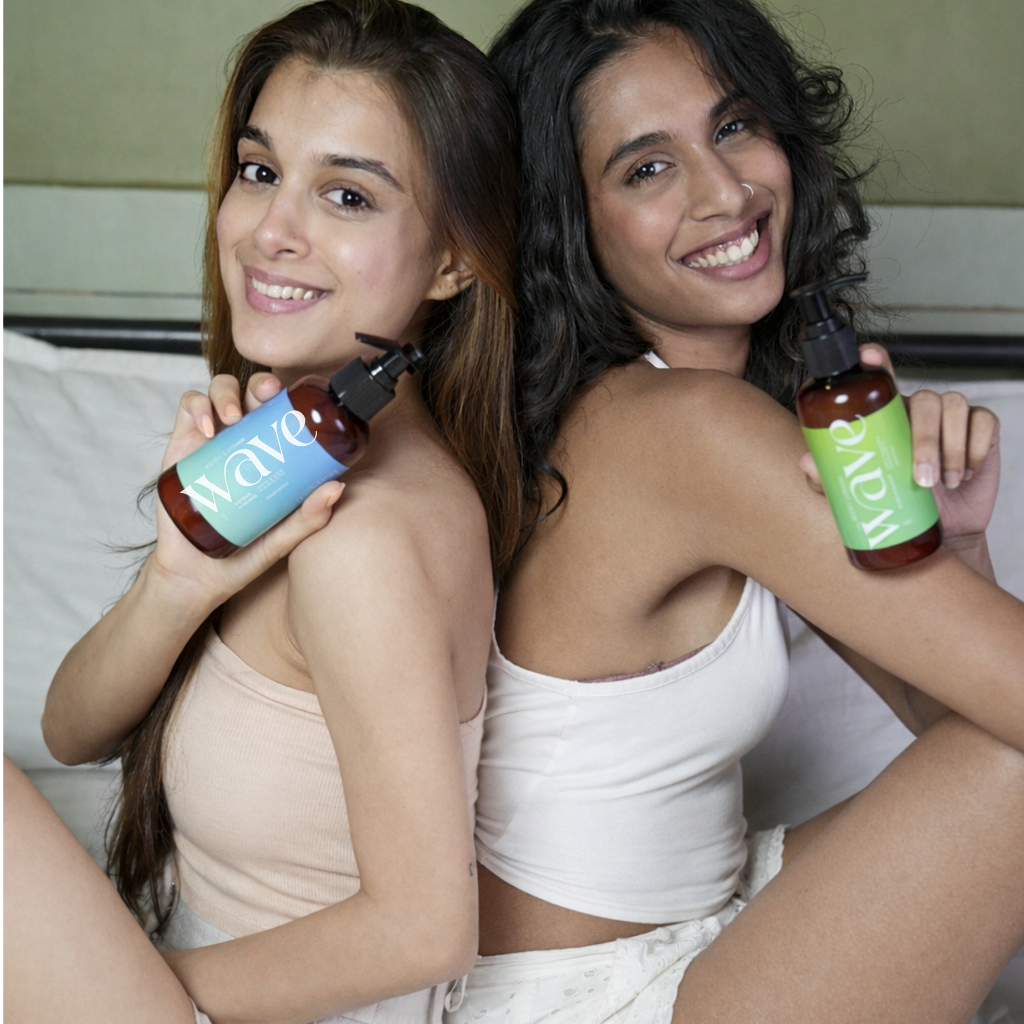
Wave of Wellness has made the choosing process straightforward — because both lotions in the range are built on the same core philosophy: lightweight, fast-absorbing, non-greasy formulas designed for India's climate, with actives that produce real visible results. Neither is a heavy cream. Neither requires compromises on feel or efficacy. Both are designed for daily use, every day, regardless of skin type or season.
Glow & Protect Body Lotion is for anyone whose daily priority is a brighter, more even, more protected complexion. Powered by Vitamin C, Niacinamide, Vitamin E, and SPF 18, it visibly brightens dull skin, reduces pigmentation, and provides daily UV and pollution defence. The multi-oil and butter base — Shea Butter, Cocoa Butter, Coconut Oil, Sweet Almond Oil — delivers genuine nourishment without any heaviness. Glycerin, Lecithin, and Phospholipids reinforce the barrier and lock in hydration all day. In an 8-week study, 93% of users said their skin looked brighter and more even. 97% confirmed no stickiness or white cast — even in warm, humid weather.
Hydrate & Protect Body Lotion is for anyone whose daily priority is deep, sustained nourishment — skin that stays soft, smooth, and comfortable from morning to evening without feeling like it's coated in anything. Built on the same multi-oil and butter complex, with Aloe Vera, Shea Butter, Niacinamide, and SPF 15, it delivers lasting softness and barrier reinforcement in a formula light enough to use daily in every season. This isn't a winter lotion or a dry-skin-only formula — it's a smart everyday moisturiser for any skin type that wants nourishment as its foundation.
Both are paraben-free, silicone-free, sulfate-free, and vegan. Both are made in India, for Indian skin, in India's conditions.
For best results, pair either lotion with the Triple Action Exfoliating Mist — applied on clean, dry skin before your lotion step. Freshly exfoliated skin absorbs moisturising actives significantly better, which means every drop of your lotion works harder. Cleanse → Treat → Moisturise: the complete Wave routine.
Quick Guide: How to Choose the Right Body Lotion
| Your Priority | What to Look For | Wave Pick |
|---|---|---|
| Brighter, more even skin tone | Vitamin C + Niacinamide | Glow & Protect Body Lotion |
| Daily UV protection | SPF 15+ in formula | Both (SPF 18 / SPF 15) |
| Deep nourishment, all day softness | Multi-oil & butter base + barrier actives | Hydrate & Protect Body Lotion |
| Clean formula, no nasties | Paraben-free, silicone-free, vegan | Both Wave lotions |
| Lightweight for warm weather | Fast-absorbing, no white cast | Both Wave lotions |
| Complete body care routine | Cleanse → Treat → Moisturise | Mist + either lotion |
```
The Bottom Line
Choosing a good body lotion doesn't require reading a chemistry textbook. It requires knowing three things: what ingredients to look for, what to leave on the shelf, and how to use it so it actually works.
Start with a clean formula. Look for humectants, emollients, and barrier-supporting actives. Apply it on damp skin, consistently, every day — and give it four to six weeks to show you what it can really do.
That's how you choose like a pro.
Find your match: Shop Glow & Protect Body Lotion → Shop Hydrate & Protect Body Lotion → Shop the Full Routine →
-
Posted in
Hydration